A real light bulb moment came for me a couple of years ago. Our athletic director and I were brainstorming ways to make expanding sport psychology happen at our school. At that time I'd taught four total sections of the class (two each semester) and worked with a handful of teams after throwing out the idea at a beginning of the year coaches meeting. Anyone with experience in public schools knows funding can be a real challenge so we were somewhere between a lemonade stand and raffling off a kidney when it struck us. I'd always go on about, "Sport psychology is really performance psychology, and we're all performers. It's for everyone." Why are we only thinking of athletes? With that came a pitch to an assistant principal and then principal about the idea of expanding mental performance coaching to classes and other groups as well. I sent out a feeler via schoolwide email (maybe my first ever) asking if teachers would be interested in this the following year. The response was very positive, and one AP Literature teacher even said she didn't want to wait until next year. So we didn't. We did a series of sessions leading up to her students' AP test. I wasn't sure how the students would respond or how I'd enjoy working in the academic setting. It ended up being a blast, and her students were engaged and did really well with our sessions. I'll forever be grateful to that teacher for giving up time in class to allow me to share. It helped things springboard into the next year.
Since then, our mental performance program, thanks to a lot of help from countless people, has evolved into truly being for everyone. I've had the opportunity to do sessions with theater, choir, dance, and student activities. I've been a guest in classrooms ranging from self-contained all the way to AP and in a variety of core classes. We've done something called High Performance Teachers where 15-20 of our teachers came to sessions on subjects related to them individually. We also started a Captain Class leadership group for a group of our student activities and fine arts student-leaders. A Sleep Study Focus Group launched this year where about thirty of our faculty and staff have been educating ourselves on the importance of sleep with hopes for helping students and staff improving theirs. With the expansions have come hard lessons on the effects of doing too much which has led to a scale back this year, but I hope to strike more of a balance in 2019-2020. Sport psych may be for everyone, but it can't be delivered to everyone all the time. That's a great challenge to have though and one I wouldn't have seen coming three years ago.
- Coach Ehrlich
Thursday, May 30, 2019

Wednesday, May 29, 2019
A New 26: D is for Debrief
Activities are a big part of what I do in working with classes and teams. Very few young people, after sitting and listening to adults talk for the majority of the last eight hours, are interested in a 30 minute lecture when it's time to be out on the field/court/etc. With most sessions I try to balance activity and discussion. This is something I learned through teaching and relearned as a mental coach during a summer with IMG Academy. Most of the time I use the activity to start the session. This has proven futile at times. There are some groups who once we go to a high energy activity have no chance of settling down for a discussion (maybe an impromptu lesson on energy management). Overall, I find activities to be really valuable. They can be at least. Experiential learning is more enjoyable and more effective than just listening to someone talk. Few activities can stand on their own though. It's not enough to do an activity just for doing an activity's sake. The activity needs purpose, and a good debrief can be a great collaborator in driving home that purpose.
Not all debriefs are created equally. I've found there to be two very different types that have each brought about really cool lessons learned and helped with the idea of the students/athletes/performers driving the learning experience. The first is very purposeful. This is when I've taken the time to think through what I'm hoping they will get from an activity and guide them to those answers with the questions asked. For example, today we did a team building activity with the cheer team that involved using each other's names. I asked them after the activity how many of them where confident they knew all of their teammates names. Not everyone raised their hand. This led to a good discussion, driven by other questions, on the power of really knowing each other as people and why it's important to know and use peoples' names. The second type of debrief is one I'll leave very open-ended. We play some different sports in class. Many students don't actually play a sport, and all will play a sport within the class that they don't play. I really want them thinking about how they can use the concepts from class beyond our 45 minutes together and may simply ask, "What'd you learn that you can apply to what you do?" This has led to some really cool thoughts. It's amazing what young people will say when we stop talking every now and again and just listen. In reality, both purposeful and open-ended debriefs end up changing as we go because I really challenge myself to listen and trust myself to go where the discussion leads. This is something that has come with experience and reflection. When I started with teams I'd feel so often like I left some really cool questions and answers on the table. While it still happens, I find it happening less as I obsess less with, "Did I get my point across?" and go more with "Did we get a point across?" That's the fun of mixing science with art. That's the fun of coaching.
- Coach Ehrlich
Tuesday, May 28, 2019
A New 26: C is for Confidence
An estimated 50% of what I do as a high school mental performance coach is deprogramming bad information young people have been hearing for years. You know, the kind of stuff that gets 100s of RT on Twitter but is ill-informed, at best. Here's an example:
"If you don't feel confident, you might as well not even show up."
If people followed this advice, there'd be a whole hell of a lot of absences in sports. There'd be automatic outs in baseball. Penalty kicks skipped in soccer. Teams playing with 3 players against 5 in basketball. It'd be a game changer for sure. Many people think of confidence as a feeling. While feelings of confidence are real, and we'd all love to feel confident all of the time, the reality is we aren't going to. And that's okay. The legendary Ken Ravizza used to say something to the effect of, "Are you so bad you have to have your A game in order to compete?" What I think he was saying is it's less about how we feel and more about who and what we are. Who and what we are build over time. Through repeated efforts, the testing of those efforts, and adjusting accordingly. We're built through experience, both successes and failures, and how we respond to that experience.
When we don't give our efforts and experiences enough credit we do ourselves a great disservice. That big time power you have? It's because you've taken countless swings and lifted weights. It doesn't disappear when you strike out one time. Your pull up jumper? You don't lose the ability to take and make it based on one possession or a rough game. Your ability to outrun defenders isn't gone because of that sarcastic comment your coach made when a slower player caught you. What I'm getting at is you've likely earned more confidence than you give yourself credit for. All of what you've done, both on and off the field, are contributors in building your confidence. Now, there's a flip side to that too. Want to get more confident? You're going to have to earn it. It's not done through moving your hands back a little bit and then hammering a line drive. It's not going to come through one really good touch and cross to a teammate for a goal. Those experiences count and may unlock the realization you can do something, but you're going to need to do it over and over to build who and what you are. To build real confidence. PUT HERE
There's a graphic I love from a book I love called The Confidence Gap. I've included it below. It's how you build confidence. I hope you find it useful. You've probably earned more than you realize. The good news is you can act even if you don't feel like you have, and the way to build that confidence is through the action. Keep acting. Keep earning. Keep being... You.
- Coach Ehrlich
One of my favorite moments to see (I know, I know. I've got lots of favorite moments. Deal with it.) is when someone has a light bulb moment where they realize something that used to be a weakness for them is now a strength. Recently a graduating senior who'd played soccer wrote a thank you note and included something about how she'd gained a lot of confidence over the last three of years. Confidence used to be a weakness for her. Gaining confidence in confidence? My head almost exploded! That is real confidence building at its finest and a tremendous credit to the young lady mentioned for all she put in to improving herself as a player and person throughout her experience.

Monday, May 27, 2019
A New 26: B is for Be You
Longtime followers will recognize "Be You." Be You is a concept that drives my philosophy as a mental performance coach. For me, development and life is about the never ending process of exploring and being a better version of yourself. Be You isn't an excuse but a driving factor in how you learn and what you do. To be yourself, you first need to know yourself. This means building self-awareness: knowing your strengths, your weaknesses, how you respond in different situations and why, etc. I read a great Harvard Business Review article a few months ago that said, "although 95 % of people think they're self-aware, only 10 to 15% actually are. I think we can raise that percentage by providing some help.
At the high school level, there is a lot of temptation for comparison. School academic rankings, siblings, star ratings for athletes, the list could go on for seemingly ever. Add to that the pressures that come with the false portrayals of our lives on social media as perfect, post after post, and it can be challenging to be a kid today. Oh yeah, I forgot. High-school-aged students are also beginning the natural sociological phase of a search for self. They aren't little kids anymore but are yet to become adults either. Gone are the days of blindly believing in and doing whatever adults tell them. What to do? Much of what we do in the sport/performance psychology class I teach and work I do with groups and individuals is in an attempt to help young people discover and understand who they are and the why behind what they experience. By recognizing strengths they're able to believe in themselves more. With the awareness of weaknesses come opportunities to grow. Building an understanding of why they get jittery and an elevated heart rate before a presentation allows the opportunity to then take control of themselves and their response. What can you do about this as a coach? Something I think can't be overvalued is starting the conversation. Ask them what they think their strengths are, their weaknesses, what helps their performance, what hurts it, why they play, and so on. Help the young people you work with to start recognizing and believing in who they are while also keeping an eye and building the road map for who they could be down the road. They'll be better off for it, and we'll all be better off for raising that 10-15% discussed earlier.
- Coach Ehrlich
Sunday, May 26, 2019
A New 26: The ABCs of High School Mental Performance Coaching
Four years ago, which in some ways feels like only yesterday and in others like an eternity ago, I did a blog series called The ABCs of Sport Psychology The series was twenty-six straight days of blogs on topics starting with letters A through Z. The passing of four years has come with many new experiences and lessons learned. Four years ago I was just wrapping up my first "real mental coaching" with a college baseball pitching staff. Now I find myself approaching the end of year three as a high school mental performance coach. It's a role, like any, that comes with great rewards and great challenges, and it's one I'd love to see spread to more high schools. With that, I'm going to try for "A New 26." The New 26 will be a mixture of concepts and lessons learned central to what I do at our school. While they'll focus on the high school level, my hope is you'll be able to think about how they apply to you no matter what you do or what level you do it.
A is for Ask questions. When I started as a mental coach, I found myself constantly seeking to prove. I wanted to prove I knew what I was talking about. Prove I could help. Prove there was a better way of thinking about performance. My intentions were there, but my methods were misguided. With that "wanting to prove" attitude came a lot of talking and a lot of telling. "You should do this." "This is what elite performers do." This was especially present in one-on-ones with athletes. At the end of throwing so much at them, I'd no doubt overwhelmed instead of helping to find clarity. As I've grown more as a mental performance coach, my methods have shifted. I tell less and ask more. Listen to listen instead of listening to respond. Pick my spots only if an opportunity presents itself instead of forcing one that isn't there. While there are many reasons for the shift, the main one is I want the athletes to feel responsible for their path to performance. If they give me credit for their performance, I view that as a failure. My hope is for performers to get to where they either have the answers they're looking for or have the ability to find them. One of my favorite experiences to see is an athlete, at the end of a conversation, realizing they'd been the one who came up with the answers. The last thing we want is an athlete feeling like they need us to perform. We want to help them empower themselves to perform and understand their performance.
How does this relate to you? If you're a coach, challenge yourself to do less telling and more asking. You want athletes to be able to react and adapt on the fly to new situations competition and life may throw at them. They need to be empowered to do so. That won't happen if we constantly spoon feed answers. Beyond the playing field, the same concepts apply. We want them to realize they have the skills to adapt and persist through whatever life throws as well. At the high school level, sports are educational. Asking questions is a great help in that process.
- Coach Ehrlich
Sunday, May 19, 2019
Working with Young Leaders: Lessons Learned the Hard Way
One of the parts of my job I love the most as a high school mental performance coach is getting to work with young leaders. Their interest and efforts to grow in their roles can be inspiring. A couple of years ago our athletic department started a student-athlete council as a way to teach a small group a bit about leadership and allow them to have a voice in their experiences. That group has evolved, in both size and content, into what we now call The Captain Class. The Captain Class name comes from a book by Sam Walker on the traits of the best captains in sports history. What I love about the traits is they're based on Sam's years of research and devoid of the usual leadership fluff like, "Great leaders are always positive!" Actually, no they aren't. Nobody's always positive. The traits also have a long list of potential connections with sport psychology. Those are what spark our sessions together. Our school's Captain Class is selected through nominations from each of our teams' head coaches. For most teams, we try to select one senior who will be a captain and one underclassman who coaches think could develop into a captain. We get together monthly at lunch with a mixture of lessons, pizza, and open forums. We also visit local elementary schools. Although technically our athletic director, assistant athletic director, and myself teach the sessions, our Captain Class members teach us probably more than we teach them. It's that teaching that inspired me to get back to writing with this blog. I want to share a few lessons I've learned in working with young leaders. These lessons have been learned the hard way. For the sake of time and not wanting to publicly share the stories accompanied by the lessons, I've chosen to keep the lessons short. Here they are:
*The best kid you've ever taught/coached is still a kid and still human. They're not going to be perfect, and we shouldn't expect them to be. We also need to do more to help them realize they don't need to be.
*Shame on us if we purposely guilt a kid for having interest and/or responsibilities outside of whatever we're in charge of. That's an us problem, not a them problem.
*Being a great kid doesn't automatically prepare you as a leader. It's not enough to just throw kids into leadership roles. We need to balance the throwing in with guidance that has substance.
*Along those lines, your best player or the person who's the best at whatever your group does shouldn't automatically be chosen for a major leadership role. We've all seen the, "When your best player is your hardest worker," type of quotes, and that's special when you have it. All too often, however, we overvalue the importance of on field role when choosing a leader and try to force fit the most talented into a leadership role.
*We need to provide opportunities for the "next tier" kid to grow as a leader and rise to the top. It doesn't need to be such a select group. If we think they can learn and improve, which is kind of the point of education, we need to help them see and rise to what they could be.
*When we do pick the same small group to do everything we don't just rob the next group. We risk burning out that same small group. They shouldn't be expected to do everything. That expectation can have long lasting, negative impact.
*We need to pay attention beyond what they're saying. They've been trained well and don't want to let you down. "I'm fine" can be accompanied by behavior that screams, "I'm not fine!"
I say I've learned these lessons the hard way because each comes with stories of situations where I feel like I've failed a kid or group of kids. It certainly wasn't my intention at the time, but with a new perspective comes the responsibility to do and be better for the next group to come along. Also there is the realization that another group of lessons learned will undoubtedly come with more experience over time. That's kind of how growth works. Anyhow, I hope your reading of this has allowed you to do some sort of mixture of rethinking and commiserating. Until next time!
- Coach Ehrlich

(Pictured above is most of our Captain Class for 2018-2019)
Thursday, July 5, 2018
Four Elements of Great Cultures
Sometimes I think it’s really easy as coaches to get wrapped up in what we teach to others. We’re excited to share great lessons we’ve learned and just know they will help whoever will listen. At times, this thirst to teach comes at the expense of remembering there are plenty of opportunities for us to learn too. That’s one of my favorite parts of my job- I’m able to learn from an incredible diversity of people who offer so much. Over the last year I had the privilege to learn from three great cultures, and I think some of the qualities they display would benefit your teams as well.
Let’s do a little visualization activity. Imagine a culture where there’s an understanding of and respect for the process and how long it takes. What do you see? What’s it sound like? What does it feel like? Imagine an environment where risk and failure are encouraged. Same. What do you see, hear, and feel? Maybe even think about taste or smell. How about a culture that engages and develops the total person? One that doesn’t just focus on the contribution you make to the group. What would that be like to you? Finally, imagine a culture that focuses on how each individual can improve while keeping a sense of what is best for the group and developing it as well? Same- what would this look like?
Chances are what you envisioned was sports related. Maybe it was a moment on a team you were fortunate to be a part of in your past as either a player or coach. Maybe it was a team you’ve read about or watched play. The cultural characteristics I described actually are elements of three of the best cultures I was around over the last year, and none of them are athletic teams. They’re performing arts groups, and I think we can learn a lot from them.
We have a really good group of performing arts at our school. Our talented and gifted drama class won a state championship and competed at the regional level. The choral program regularly produces amazing performances and performers, with many making regional and state groups. Our dance program is outstanding as well. They don’t have any competitions that I’m aware of, but they have multiple concerts yearly that are largely student-driven and are great, Although more of my time was spent with athletics, I was around enough to have the pleasure of learning from all three and got a snapshot of three tremendous, student-centered cultures that allow for growth.
Each of the groups has all four characteristics present in our visualization activity. The first is an understanding of and respect for the process and how long it takes. There is a daily routine of sorts that is intentional in what it does for students and the group. They also really get that it takes time to develop a great performance or performer. I think a major factor for this is the split of practice and performance time. It’s overwhelmingly skewed in the favor of practice. You may work an entire school year for something you perform once or, at most, a handful of times. Compare this to sports where you compete weekly and as much as four times in a week. This demands patience, persistence, and a direction- it demands a process.
The second characteristic is they all create environments where risk and failure are encouraged. One of my favorite interactions of the year came during a session with a biology class. Our discussion was about stress, and we were talking about how stress can be good. One of the students I knew from sport psychology was a member of the choir program, and here's a piece of our conversation:
Me: Yall go for it and try new things in chorus right?
Student: Oh yeah.
Me: Like it?
Student: Love it.
Me: Why?
Student: Because I want to learn!
Me: Why else?
Student: Because we can do it and fail and it’s okay because it’s safe.
That was such a cool thing for anyone to say, and it was all the more impressive coming from a 14-15 year-old freshman. What makes it even better is that if you asked any random assortment of 10 choir students about the same concept an overwhelming majority would speak similarly. Oh yeah, and safety is actually one of the three traits of great cultures Daniel Coyle discusses in Culture Code. That made it even cooler.
A third characteristic present in all three groups is an environment that allows for talking about other things and values the total person. That’s something I think some teams miss at times. There’s so much focus on being busy and focused on whatever skill or drill being executed in our strict amount of time that we forget to take a deep breath and realize we have people playing sports who all hold other valuable roles in their lives. Because it’s unrealistic to “just act,” “just sing,” or “just dance” for hours upon end, there is some inevitable down time for drama, dance, and choir where it doesn’t look busy. Students are sitting around talking about other things. This down time is crucial for getting to know each other though and creating an environment of trust. Trust is yet another essential component to great cultures. The conversations allow for group members to see each other as more than whatever role they may have in the group’s performance. This is great culture.
Finally, all three of the groups mentioned do a great job of developing individuals within the group concept. If I ask one of the teachers about a student, they will have a story about how that student has come a long way and how proud they are of the student. These stories are equal in how they value performer and person. Each group allows students to take leadership roles and fosters accountability. Drama, as an example, has a group of students who are in charge of everything related to stage management and tech. Dance will have many pieces that are choreographed by students. Chorus had the ability to function really well even as the teacher was out for weeks with a serious knee injury. We talk a lot about taking control of your process and responsibility for your performance- this is it!
That’s a lot on the what and how of some great cultures, but I’d be remiss if I didn’t mention the all important “why” to what makes these cultures. All three of their teacher leaders are incredibly selfless with their time and energy in working with the students. Like coaches, they spend many a morning, lunch, and late evening giving more of themselves that what is requires. And they don’t even get that huge coaching stipend! Beyond that, they are learners who practice what they preach with regards to the great expectations they have for those in their groups. They’re three special people, and we’re lucky to have them at our school. If you’re a coach reading this, chances are you have people just like this around wherever you work. I’d recommend seeking them out. The lessons may not be quite as clear as those from your coaching buddies, but they may just be more valuable in building the kind of culture you want.
Last but certainly not least, challenge yourself to incorporate some of these characteristics of culture on your teams. Do you have an environment where it's safe to try new things? Do you allow for the development of individuals within the team concept? When's the last time you had a conversation with each member of your team about something that had nothing to do with your sport? Does your team and its individuals really have a process for improvement and performing? Just a few things to consider. Chances are there are areas you're doing a great job with, and it's okay to pause and celebrate that. You probably could do a little better with at least one. That is okay too. Great cultures are constantly in development.
Last but certainly not least, challenge yourself to incorporate some of these characteristics of culture on your teams. Do you have an environment where it's safe to try new things? Do you allow for the development of individuals within the team concept? When's the last time you had a conversation with each member of your team about something that had nothing to do with your sport? Does your team and its individuals really have a process for improvement and performing? Just a few things to consider. Chances are there are areas you're doing a great job with, and it's okay to pause and celebrate that. You probably could do a little better with at least one. That is okay too. Great cultures are constantly in development.
Sunday, January 21, 2018
Lighting Flames: Challenges in HS Athletics: "I Win, or You Cheated"
One of the things that is great about my position at our school is I get the opportunity to work with a really wide range of students in a variety of different arenas. We have four sections of sport psychology, I work with a group of academic classes and performance groups, and I also get to help with quite a few of our athletic teams. In working with so many themes tend to emerge. That got me thinking about some of the common challenges I see with student-athletes. The term choice of challenge is purposeful. Our perspective is everything. "Problem" = negative, "Challenge" = opportunity. You see, I try to subscribe to the message behind a quote from Harvey Dorfman, "Instead of cursing the darkness, light a flame." In other words, instead of just complaining figure out a solution. If it's something you aren't able to have any influence over, let it go instead of allowing it to consume you. Something I have to continuously work on for sure. With that, this is going to be the first in a series of shorter posts encouraging us to "light flames" with some of the challenges faced.
*I win or you cheated.
Amazingly, we have rewritten the possible outcomes of competition. I first noticed this one in class. We were playing around with some Concentration Grids online, and one student got a really low time. Instead of congratulating the student, immediately 5-6 students blurted, "You cheated!" It was like they'd been programmed to do so automatically when losing. I started to think back and realized it'd happened just about every time we competed in class. Not only that, so many times athletes would have stories of "being cheated by the refs" if they lost. Really this attitude carries over to many situations. Either I play, or my coach hates me. I get a good grade, or the teacher can't teach. "I win, or you cheated." What's consistent is a lack of responsibility for performance.
So what can we do about it? Remember, we're about "lighting flames." One solution is found in a matter of perspective. Many students think they're supposed to be perfect. A loss is taken as reflective of a lack of ability or an attack on their self-worth. We can help them to see this doesn't have to be the case. Everybody loses. Everyone. There is no exception. Nobody drifts through life succeeding at everything. Losses can be opportunities to learn so we can improve if we allow them to be. Taking responsibility can be incredibly powerful. When things go poorly, it allows us to understand what role we played and seek opportunities for improvement. When things go well, it allows us to rightfully take credit for hard work and execution of skills. Parents and coaches, don't rob the your children/athletes of this opportunity by feeding into the norm of blaming others. Part of what makes competition great is learning how to both win and lose with grace- knowing you did what you could to compete within the rules.
I know it's easy to look at the "why" for people having the attitude of "I win, or you cheated," and get stuck (cough cough... politics), but let's do something about it instead. Instead of taking a loss or failure as a personal attack, let's help set the tone that it is just an experience like any other. There's a popular quote in sport psychology saying, "Either I win, or I learn." I like it but would love to take a different perspective there too. Instead, I prefer, "I learn regardless of the result." Every single conversation, class, practice, game, etc. is an opportunity to learn. Separate your worth from the result to allow yourself to learn as much as possible. Until next time, go light some flames!
- Ben
Friday, November 24, 2017
A Different Approach to Teacher Retention
Teacher retention is a hot topic in education. More and more articles are published talking about potential teacher shortages due to issues with recruitment and retention. The common solutions are pay teachers more, and give us more respect. While I wouldn't turn away an increase in salary, I think we are missing the mark. Teachers don't get into the professions for the pay. It doesn't seem right to me to then blame it for why we're leaving. In a field where we are tasked with the role of helping students to use logic in decision making, that comes up short. A teacher in the article I read yesterday suggested that teachers "should be treated like rock stars." She's close, but I think teachers should instead be treated like elite athletes. Before you go there, let me stop you. I'm not saying we should be paid millions of dollars. What I'm saying, rather, is teachers should be treated like elite athletes when it comes to training and support. We should help them to help themselves.
At the forefront of the elite athlete treatment for teachers should be mental performance training, sport psychology. Sport psychology, a rapidly expanding field, is really performance psychology. It's a field focused on helping performers to better understand who they are are, what they do, and how they can do it better. Over the last several years, I've dived into the field of sport and performance psychology. I have read, talked with others within the field, and gotten a masters degree related to the topic. In addition, I have had the great privilege of a wide variety of experiences working with performers at a variety of skill level. Over the last year and a half I have served (unofficially and now officially) as our school's Mental Performance Coach. The role has me working with many of our athletic teams, performing groups, and some academic classes. It also has me constantly searching for ways to do more and do better. With that, I thought of teachers. Teachers are asked to perform day in and day out. In reflecting more about it, the school year's athletic comparison is the long season of professional baseball where the daily monotony is referred to as "the grind." For students and teachers (because we're important too) to have the best experience possible, we need teachers to be on top of their game on a consistent basis. Mental performance training can help by helping them to realize who they are and how they are at their best.
The best performers in the world are excellent at having a present day, present moment focus. Teachers are terrible at this. Instead of focusing on this class period, we're guilty of constantly looking forward. "Only 17 days until Winter Break," "I don't know how I'm going to have those kids ready for AP testing in 4 months," "We've got to get these 9th graders ready for college!" I wish I were joking about the last one. Unfortunately, I am not. The result of all this obsession with the future? Undue stress. Lack of enjoyment and appreciation for now. Inconsistent attitudes and approaches to days. Missing out on some really cool moments because we've already mailed it in as "one of those days." Now multiply that sort of mindset by 4, 5, 20 years, and it's no wonder why people don't want to teach anymore. We are setting ourselves up to be miserable.
Great performers don't allow something to completely ruin their ability to keep perspective. Again, this is a big challenge for teachers. "Let me tell you about this email I got from a parent," turns into "Parents just don't respect us at all." "Can you believe what this student said when I asked him to put his head phones up?" turns into "Kids today, they just have no respect for authority." We quickly forget the 201 other parents who didn't send a nasty email. What about the 1900 other students whose behavior was without issue? We lose perspective, and we let ultimately little things bother us more than they should.
Those are just a couple of ways performance psychology has relevance in the world of teachers. Mental performance training is becoming more and more a part of the world, and for good reason. Professional, Olympic, and college teams are all using it. Take a look at the current champion in whatever sport you like, and there's a very high percentage liklihood they are using mental training. Big corporations are as well. Education needs to be next. Helping teachers to better understand themselves and their performance, in my opinion, would help tremendously with the quality of instruction. In addition, it would allow teachers to better enjoy the experience along the way. It would help them to help themselves. Maybe that would lead to more of us sticking around like we all hope.
- Ben
- Ben
Thursday, November 23, 2017
The Be You Performance Model
Over the past several years, I've dived into the field of sport psychology and performance in general. With that has come a lot of time taking classes, reading books, watching sports, working with teams, talking with coaches and athletes, discussions with teachers, talking with others in the field of sport psychology...well, you get the picture. Just as teachers and coaches of athletic teams evolve in their philosophies, so to have I as a Mental Performance Coach. For me that is one of the coolest parts about growth in coaching or whatever we do. If we don't look back every now and then and think to ourselves, "I can't believe how dumb I was to _______(insert dumbness here)," then we aren't doing it right. I spent a great majority of the summer preparing for an expanded role at our school in working with teams and academic classes. That meant a lot of brainstorming and reflection about what I believe as a practitioner. In doing so I came up with a model I think encaptures what performance is about. It's called the Be You Performance Model (BYPM), and the graphic below illustrates the model.
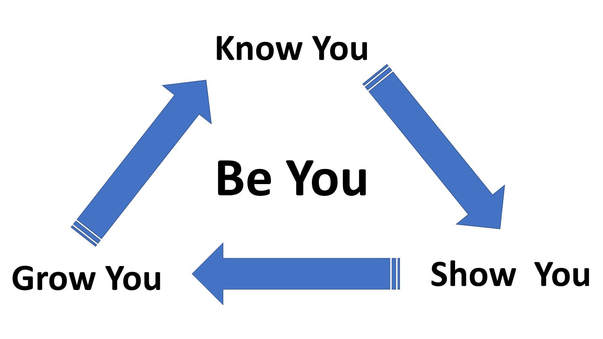
The Be You Performance Model centers around the concept of a neverending process of becoming your best self. It's neverending because we never truly reach our potential. There is always room for growth. There's always some way to get better. Too often we, as people and performers, waste time comparing ourselves to others. We should instead be comparing ourselves to past versions of who we are. A second part of Be You that connects and is of equal importance to self-growth is being confident in who we are as people and performers. Being You means being yourself and knowing that who you are right now is capable of performing and enjoying. It's authenticity. Again, just an opinion, but I think this is a major separator for high performers and people who are able to really find joy in what they do.
The Be You Model has three components that all work together to allow a performer to continue to striver for a best self. Everything in the fields of sport psychology and performance can fit into one of or multiple components within the model. The components are Know You, Show You, and Grow You. Know You is about self-awareness. Know You is about diving deep down into yourself and seeing what you find. It's recognizing one's strengths and weaknesses as a person and performer. Then, it's about understanding how that relates to performance. Show You is everything that goes into actual performance itself. Show You is about being purposeful with what you can on game day, test day, performance day, etc. in hopes of achieving the results you're looking for. Grow You is all about putting in effort to improve. Again, we are never finished products. Grow You is about purposefully discovering ways to improve AND putting in the necessary efforts to do so. Ideally, the triangular cycle of Know You, Show You, and Grow You never ends. There's always room for becoming an even better You.
Everything we do within the Mental Performance Program at our school fits into the Be You Performance Model in one way or another. Whether it's working with an algebra class on growth mindset, a volleyball team on communication, or a group of student-athletes on traits of a great captain, it all relates. Is the model perfect? Of course not. To that end, I'd love any feedback you have to offer. Feel free to reach out with any questions or comments at all. Like the performers I 'm lucky enough to work with, I am constantly trying to improve as well- I want to be my "Best You" and I'd love your help in doing so!
Sunday, May 14, 2017
Justin Turner: The Path
Something that's been fascinating me more and more is a growing trend of Major League hitters experiencing big jumps at later ages. Justin Turner, Daniel Murphy, and the resurgence of Ryan Zimmerman this year come to mind. I think I'm drawn to these cases because they go against conventional wisdom in baseball. The general thought is that players are who they are by their mid to late 20's. Justin Turner was a nice utility bat off the bench who could play a couple of different positions and spell some guys. Daniel Murphy would hit for a nice average and some doubles but not a lot of home runs. Ryan Zimmerman was a little different because he'd been hit hard by injuries, but he'd become a guy who needed to hit down in the order with some questioning whether he should be in the lineup at all or if he may need to stop playing completely. Justin Turner became a top-10 in voting MVP guy who was rewarded with a sixty-four million dollar contract. Daniel Murphy became a guy who led the league in slugging and finished second in the MVP voting. Ryan Zimmerman is hitting almost .400 through the first month plus and is the early leader for an MVP award. All three are different stories, but they speak to the value of continual learning and being open to change regardless of where you're at in your career path.
A quote by Justin Turner is the actual topic of the blog today though. It reminded me of Ryan Holiday's The Obstacle is the Way book. The entire book is great, but the main idea behind speaks to how our perceptions of what happens in live shapes how we proceed. When you're injured, for example, do you feel sorry for yourself or attack your rehab? Not playing as much as you'd like? Do you pout about it and blame the coach, or do you continue to try to improve your skills? Justin Turner is talking about how he made a swing change, added a leg kick, and worked to hit the ball in the air more often. Regardless of where you fall in that whole "Hitting Twitter" debate, it's clearly helped transform Turner. The first takeaway I have from the quote though is the understanding of the path he's taken. Everything we experience in our lives makes us who we are right now. The good and the bad both play a part. Sometimes it's tough when we are experiencing lows, but our mindset and perception can allow them to be building blocks for future successes. The second takeaway connects, but it's how he's not worried about several years ago. Why? There's no point. Although I'd love for Doc Brown to show up with a Delorean, it's not happening. We can't go back in time so there's no great value in dwelling on it. Being present and focused on the now is a valuable trait of a high performer. It's one we all can work on and improve at and something Turner is clearly referencing.
So where do you go from here? It's your choice. How will you handle where you currently are in your career or life? Maybe you're going through a really great time. You're playing well, experiencing great relationships. Great. Enjoy it. Understand why you're doing well, and look to continue to make it happen. Maybe you're slumping or not playing at all. Sorry to hear it, but my guess is it isn't the first time. It probably won't be the last either. Learn from it, and you'll move past it. Enjoy the challenge of it even. It's all part of your path.

Subscribe to:
Posts (Atom)
-
 Alex Bregman has had a monster first full season in professional baseball. He's hit a combined .310 with 19 HR, 20 2B, and an ...
-
 One of the best things about working on a staff where everyone has goals of developing as a coach and person is you get to share reso...